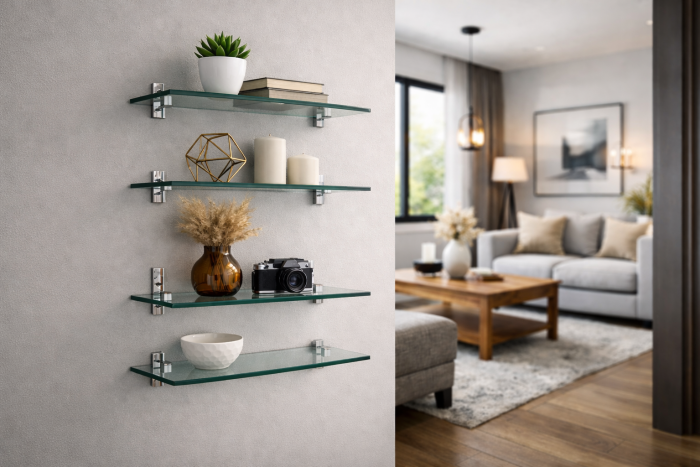
When most people hear about installing glass shelves, they picture a disaster waiting to happen. Glass cracking under the weight of books at 3 a.m., or kids being too reckless and turning a toy truck into a glass-destroyer, or a particularly jumpy cat landing on the surface once thought to be reliable enough to withstand cat jumps but then shattering and raining down at a particularly sleepy dog. A slow-motion nightmare.
But here’s the thing about modern glass engineering. It isn’t fragile anymore. It’s precise. Today glass of exceptional quality is more than a mixture of sand, soda ash, and lime, melted together. It’s a complex solution that is built to last.
Properly fabricated tempered glass shelves for cabinets are among the most durable, hygienic, and design-forward storage solutions available today. In this guide, we’re breaking down real numbers, real glass shelf weight capacity limits, and how to install shelving safely in Brooklyn homes and businesses.
Choosing the Right Glass Type: Tempered vs. Annealed
This is non-negotiable. One option is a safe and proper solution and the other is a complete opposite.
Tempered glass is heat-treated, making it 4 to 5 times stronger than standard glass. If it breaks, it shatters into small granular pieces instead of sharp shards. That’s why it’s code-compliant for shelving. Dice, not daggers.
For glass shelves Brooklyn installers use tempered panels. It’s a common practice for structural applications today. Especially in kitchens, retail spaces, or anywhere heavy items sit.
Annealed glass is untreated. It’s cheaper, yes. It can withstand some minor damage, but for shelving? Professionals generally avoid it. Annealed glass easily cracks under stress and breaks dangerously.
If you’re investing in professional custom glass shelf fabrication, tempered glass should be the baseline. No shortcuts here if you want to feel safe.
Weight Capacity: How Much Can a Glass Shelf Really Hold?
Now we’re getting to the real question: what’s the actual glass shelf weight capacity? These three variables control everything:
- Thickness
- Span
- Depth
The longer the span without brackets, the more flex occurs. Thickness resists that flex. Depth affects leverage.
| Glass Thickness | Recommended Max Span | Avg. Weight Capacity |
| 1/4″ (6mm) | 24 inches | 15 – 20 lbs |
| 3/8″ (10mm) | 30 inches | 30 – 40 lbs |
| 1/2″ (12mm) | 36 inches | 50–60 lbs |
These numbers assume uniform load, not someone dropping a brick in the center.
You’re probably wondering how thick should glass shelves be for books or barware. In Brooklyn apartments especially, 3/8″ is the sweet spot. Retail displays often move to 1/2″.
For custom glass shelves Brooklyn commercial spaces use, structural review is part of the process.
Why Load Distribution Matters
This part usually gets overlooked. A uniform load means weight spread evenly. like when books are lined across the shelf. A point load means one heavy object in the middle. Like a marble statue or a shelf-dwelling cat.
Glass tolerates uniform loads impressively well. Point loads create concentrated stress, increasing break risk. If you’re designing custom glass shelves Brooklyn homeowners rely on for display collections, it is very important to adjust thickness or bracket spacing accordingly.
Mounting Systems and Hardware Options
Here’s where structure meets aesthetics.
Floating Brackets look minimalistic. Clean. Great for modern interiors. But floating glass shelf hardware has lower overall capacity because the support is concealed.
U-Channels are aluminum or steel channels that hold the glass along the back edge. Ideal for alcoves. Higher security, less visible borders.
Stand-offs are circular metal mounts securing glass through drilled holes. Popular in retail and offices for an industrial look.
In some projects, we adapt heavy-duty mounting hardware used in glass railings for higher-load installations. Especially in commercial builds. Hardware determines safety.
Design Applications for NYC Homes & Businesses
Glass shelving isn’t just structural. It’s architectural. Open shelving makes small NYC kitchens breathe. Light passes through. Visual clutter reduces.They are amazing for bathrooms since glass is moisture-resistant and easy to sanitize. Perfect for shower niches.
Brooklyn retailers choose glass shelves because they don’t compete visually with products. The merchandise floats. Many stores increase impact by combining glass shelving with custom mirrors for retail displays. Reflection doubles perceived space and product visibility.
Glass keeps the focus where it belongs.
Maintenance: Keeping Glass Crystal Clear
Maintenance is simple if done right. Avoid ammonia-based cleaners. They can damage certain coatings over time. Use non-abrasive glass solutions and microfiber cloths.
Prevent scratches by placing felt pads under metal decor or ceramics. Even tempered glass can scratch under repeated friction.
Tempered glass shelves for cabinets resist staining, making them ideal for kitchens and bars. Hygiene-wise, they outperform wood easily.
Professional Installation vs. DIY
Here’s where confidence sometimes outruns physics. If shelving is even slightly out of level, gravity shifts load to one edge. Over time, that stress can cause slippage or failure. NYC walls complicate things even further. Pre-war plaster behaves differently than modern drywall. Anchors must match substrate type.
We’ve seen DIY installs where floating glass shelf hardware was secured into hollow sections without proper toggles. It holds for a while. Then it doesn’t and people get hurt. Professional installers measure stud placement, check level tolerance, and calculate span-to-thickness ratios before drilling anything.
That’s the difference between what just looks fine and what is pure engineered stability.
Conclusion
When it comes to glass shelf weight capacity, two factors rule everything: thickness and hardware. Tempered glass plus proper mounting equals strength you can trust.
Installing glass shelves in Brooklyn properties demand precision, be it residential kitchens or commercial displays.
If you’re planning a residential or commercial project in NYC, our team at Amber Glass Corp specializes in precision-cut shelving for any space. Contact us for a quote.