You’re planning a bathroom renovation. The tile is selected, plumbing has been updated, and now you’re deciding on the shower enclosure. Your contractor asks a common question: framed or frameless?
At first glance, the difference appears mainly aesthetic. In reality, the choice affects durability, long-term maintenance, installation precision, and overall structural performance. Understanding how each system is constructed, and how it behaves over time, helps prevent costly adjustments after installation.
This guide explains the structural differences, maintenance considerations, and installation factors behind framed and frameless shower enclosures so you can make an informed decision.
What Is a Framed Shower Enclosure?
A framed shower enclosure uses an aluminum or composite metal frame to support thinner tempered glass panels. The frame surrounds the glass on all sides, providing structural reinforcement and helping distribute weight evenly.
Because the metal frame carries much of the load, the glass panels themselves can be thinner than those used in frameless systems. This often makes framed enclosures more budget-friendly and slightly more forgiving during installation.
Framed systems are commonly available in standard sizes, making them suitable for straightforward renovations or rental properties where customization is not a priority. Some traditional glass door installations rely on framed structures when cost efficiency and standard dimensions are important.
What Is a Frameless Shower Enclosure?
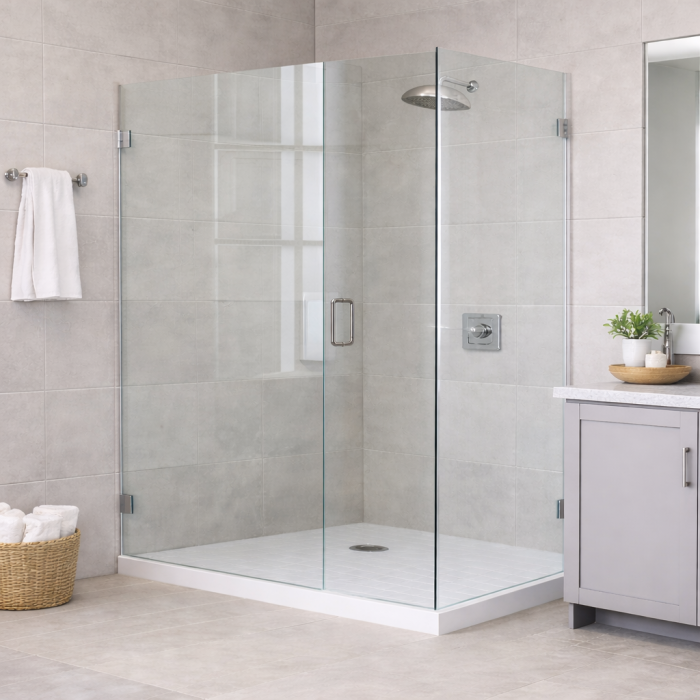
A frameless shower enclosure eliminates the full perimeter metal frame. Instead, it uses thick tempered safety glass, typically 3/8″ to 1/2″ thick, supported by heavy-duty hinges, brackets, and precision mounting hardware.
Because the glass carries its own structural integrity, frameless systems require accurate field measurements and careful alignment. There is little tolerance for uneven walls or floors. The result, however, is a clean, open appearance that enhances light flow and creates a modern aesthetic.
Many homeowners exploring custom frameless shower enclosures choose this option for contemporary bathroom renovations and long-term property upgrades.
Structural Design and Durability Differences
The most significant differences between framed and frameless shower enclosures involve structural support and glass thickness.
Framed systems rely on the surrounding metal structure for stability. The frame helps compensate for slight wall irregularities and provides additional water-channeling through built-in tracks and seals.
Frameless systems rely on thicker glass and reinforced hardware. Proper anchoring into studs and secure hinge placement are essential. Installation precision plays a critical role in preventing stress fractures and ensuring long-term durability.
A common question is: does a frameless shower protect against leaks? When installed correctly, yes. Leaks are typically caused by poor alignment, improper slope, or incorrect sealing, not by the absence of a frame.
Framed vs Frameless Shower Enclosures – Comparison
| Feature | Framed Shower Enclosure | Frameless Shower Enclosure |
| Glass Thickness | Thinner tempered glass | Thick tempered safety glass |
| Structural Support | Aluminum frame supports panels | Hinges and brackets support panels |
| Water Sealing | Frame channels & rubber seals | Precise alignment & minimal seals |
| Installation Tolerance | More forgiving | Requires exact measurements |
| Appearance | Visible framing | Clean, open look |
| Maintenance | Tracks collect residue | Easier cleaning |
| Customization | Often standard sizes | Fully custom |
| Cost | Lower | Higher |
| Best Use | Budget projects | Modern renovations |
While framed enclosures provide additional reinforcement at a lower cost, frameless systems offer improved aesthetics and simplified cleaning when installed properly.
Maintenance and Long-Term Performance
Maintenance is another important factor.
Framed shower enclosures contain metal tracks and rubber seals where moisture, soap residue, and mold can accumulate. Regular cleaning is required to prevent buildup inside the channels.
Frameless systems have fewer crevices, making them generally easier to maintain. With minimal hardware and no full metal perimeter, cleaning typically involves wiping down smooth glass surfaces and checking silicone joints periodically.
Hardware quality also affects long-term performance. Heavy-duty hinges and brackets in frameless systems must be properly aligned to prevent sagging over time. In both systems, professional installation plays a larger role in durability than many homeowners realize.
Homeowners upgrading to glass partitions or open bathroom layouts often prefer frameless systems for reduced visual bulk and simplified maintenance.
Installation Complexity and Measurement Accuracy
Installation precision is where the two systems differ significantly.
Framed enclosures can tolerate minor wall irregularities because the frame compensates for slight deviations. This makes them somewhat easier to install in older properties.
Frameless enclosures require precise laser measurements. Walls must be evaluated for plumb alignment, tile surfaces must be level, and anchor points must be structurally sound. In Brooklyn brownstones and older NYC apartments, uneven surfaces are common, requiring additional adjustment planning before fabrication.
Improper shower enclosure installation can lead to leaks, misalignment, or stress on glass panels. Professional measurement and fabrication are essential, especially for frameless systems where tolerance margins are smaller.
Cost Considerations Beyond the Glass
Cost differences extend beyond glass thickness.
Framed enclosures typically have lower material costs and simpler hardware. Labor time may also be slightly reduced due to greater installation tolerance.
Frameless systems involve thicker glass, reinforced hardware, and custom fabrication. The installation process may take longer due to precise alignment requirements. In NYC properties, factors such as elevator scheduling, building access restrictions, and coordination with contractors can also affect overall project cost.
When evaluating budget, it is helpful to consider long-term maintenance and aesthetic goals rather than upfront price alone.
Which Option Is Right for Your Bathroom?
Choosing between framed and frameless depends on your project priorities.
A framed enclosure may be appropriate if:
• Budget is the primary concern
• The opening is standard size
• The property is a rental unit
• Minimal customization is required
A frameless enclosure may be worth considering if:
• You are completing a modern renovation
• You want a clean, open design
• Long-term property value matters
• Custom sizing is needed
Both systems can perform well when installed correctly. The key factor is precise measurement and professional installation.
If you are planning a bathroom renovation in Brooklyn or anywhere in NYC, working with experienced installers ensures your enclosure fits properly and performs reliably over time.